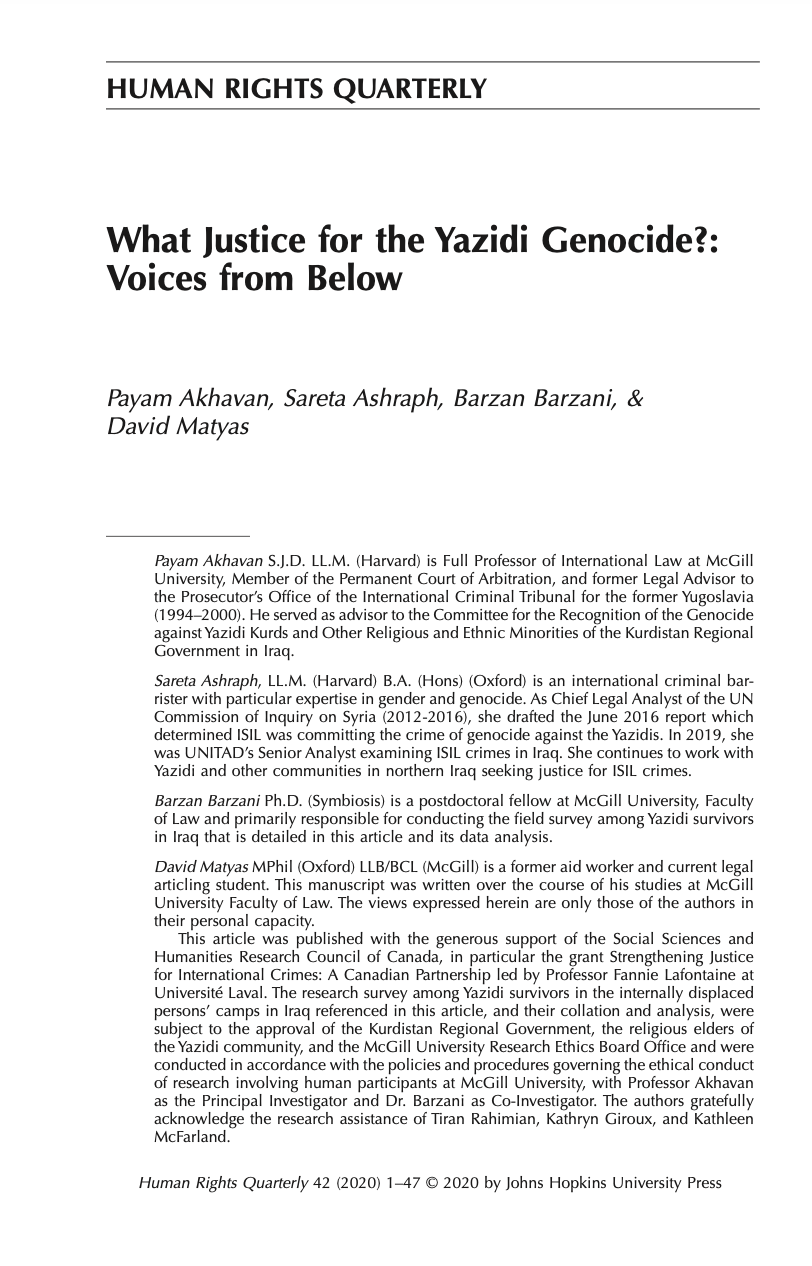
IPS Visiting Fellow of Practice Sareta Ashraph co-authored an article, What Justice for the Yazidi Genocide?: Voices from Below, in Human Rights Quartlery, with along with Payam Akhavan, Barzan Barzani, and David Matyas. Against the backdrop of the ISIL genocide against Iraq’s Yazidi minority and calls for prosecutions before either the ICC, Iraqi court, or other national courts, the authors ask a seemingly simple, though largely unexplored, set of questions: what does this idea of “justice” mean for the survivors? Do they prefer retributive or restorative justice? Do they favor global or local justice? Do they share the perpetrator-victim narrative that is so often promulgated, or is theirs a more complex and nuanced story?
To answer – or at the very least explore –these questions, the authors conducted extensive field research consisting of structured questionnaires supplemented by unstructured narrative-style interviews. The field interviews comprised among more than 1,000 internally displaced persons (IDP) – primarily Yazidi survivors, as well as other minority groups – in the largest IDP camps in Iraq’s Kurdish Region. The data that emerged provided an illuminating glimpse of grassroots perspectives, with responses that are both predictable and unexpected, multilayered and complex. What emerged is an understanding of justice principally focused on local issues, immediate concerns, agency, and prospects of a better future – features more readily achievable through local restorative justice rather than global punitive justice. This included a predilection for financial assistance, truth-telling and public recognition, and a need for healing and reconciliation among local communities and, more intimately, neighbors. With many of the Yazidi respondents being adult female survivors of ISIL crimes, this study also provides a unique insight into perceptions of justice of Yazidi women and specifically of female survivors of sexual violence.
These results underscore the need for scholars and advocates to make a concerted effort to listen to the voices from below before defining “justice” narrowly as accountability through criminal trials. The early and continuing prioritization of the ICC, and the near-singular focus of energy and resources on this objective, has undermined the pursuit of more restorative forms of justice.