What drives public support for military intervention—costs and outcomes, or something deeper?
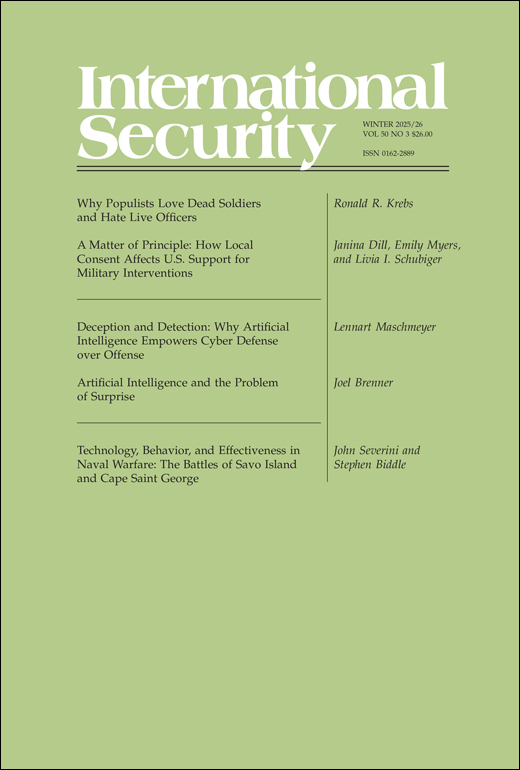
A new article published in International Security challenges a long-standing assumption in foreign policy debates. While conventional wisdom suggests that support for war is primarily shaped by cost-benefit calculations, this research shows something more fundamental is at play: principle.
The key finding: Public support in the U.S. significantly increases when local populations consent to intervention—even when the mission is low-cost and likely to succeed.
U.S. policy elites regularly claim that local populations welcome U.S. military intervention on their territory, which implies a powerful moral justification for war. Does the consent of the “intervened population” affect U.S. public support for military intervention? A large literature shows that U.S. support for war follows cost-benefit calculations. In this view, ordinary Americans are prudent, not principled, about war—specifically, they support low-cost interventions that are likely to succeed. Yet our conjoint survey experiment finds that American respondents do take a moral position regarding military intervention. In the experiment, we asked 3,360 U.S. citizens to evaluate ten hypothetical military intervention scenarios with attributes that we varied randomly. The results show that local consent significantly increases support for war on average, even when the intervention is predicted to be costless. This finding is consistent with the anti-paternalist position that using force for the benefit of others requires their consent as a matter of principle. Our study contributes to a recalibration of the roles of principled and prudential considerations in U.S. support for war. The importance of consent and the principled logic behind its effect on support for military intervention suggest that policy elites concerned with the democratic legitimacy of U.S. wars should identify the actual views of the population where the United States militarily intervenes.