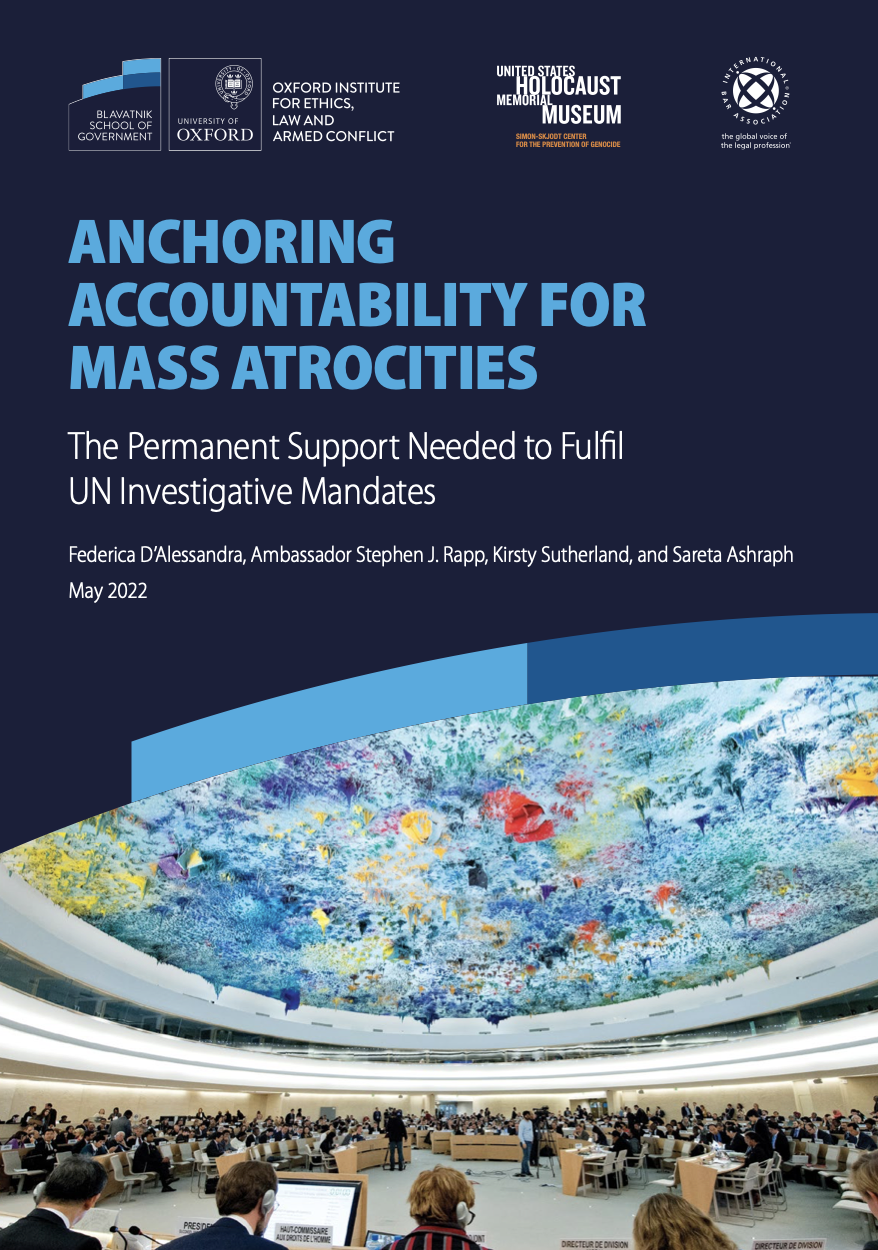
On 18-19 May, the Oxford Programme on International Peace and Security (IPS), with the support of the Simon Skjodt Center for the Prevention of Genocide (CPG) of the US Holocaust Memorial Museum and in partnership with the International Bar Association (IBA), hosted a conference in Geneva in advance of the launch its newest report, Anchoring Accountability for Mass Atrocities: The Permanent Support Needed to Fulfil UN Investigative Mandates. The conference took stock of the evolution of the international justice ecosystem and discussed the way forward to anchor accountability for mass atrocities and best support UN investigative mandates moving forward. Session 1 discussed the role of non-governmental organisations and civil society actors in documenting atrocities and their contributions to accountability, particularly their needs and wants and how these might best be served by a permanent support structure. Session 2 addressed the needs of investigating and prosecuting authorities and how coordination between prosecuting authorities and civil society documenters might be improved, as well as the role that a permanent structure could play at the intersection of the two. Finally, Session 3 explored the needs of UN accountability mandates and how these can be best supported at every stage.
On 19 May, the conference culminated in a high-level panel to discuss the report’s main findings and recommendations, including the two potential models identified to build and support the UN investigative capacity: (1) an Investigative Support Mechanism (ISM) and (2) an Investigative Support Division (ISD) within OHCHR. Speakers included H.E. Ambassador Kurt Jäger, Permanent Representative of Liechtenstein to the United Nations Office at Geneva; H. E. Ambassador Beth Van Schaack, US Ambassador at Large for Global Criminal Justice; H.E. Ambassador Katharina Stash, Permanent Representative of Germany to the United Nations Office at Geneva; Sam Zarifi, International Commission of Jurists Secretary General; Michelle Jarvis, IIIM Deputy Head; Nicholas Koumjian, IIMM Head; Myriam Fillaud, UNITAD Senior Political Adviser and Head of New York Office; Paul Oertly, OHCHR Legal Counsel; Ambassador Stephen Rapp, ELAC Visiting Fellow of Practice; Federica D’Alessandra, ELAC Deputy Director, Kirsty Sutherland, ELAC Visiting Fellow of Practice; and Sareta Ashraph, ELAC Visiting Fellow of Practice.
On 23-25 May, Ambassador Rapp and Federica travelled to the Hague to brief the Group of Latin American and Caribbean Countries (GRULAC), Finland, Australia, and Japan on the report’s recommendations.