The Law, Ethics, and Nuclear Deterrence working group is part of the Rethinking Nuclear Deterrence Research Network, funded by the John D. and Catherine T. MacArthur Foundation. The scope of this working group is to take a systematic look at nuclear doctrine and planning across nuclear states in light of legal developments over the last fifty years. In addition, we seek to address the complex ethical issues involved in developing deterrence doctrines in an era in which nuclear weapons are becoming more accurate with lower yields.
International law categorically prohibits the intentional targeting of civilians and civilian objects. Yet, since 1945, as nuclear states have formulated doctrines for nuclear use and deterrence, their policies have involved threats against civilians. Over the last fifty years, the laws of armed conflict have permeated military doctrine, operational planning, and the conduct of hostilities in many Western militaries. Yet, nuclear doctrine and planning have remained at least partially insulated from these developments. When the United Kingdom ratified the 1977 Additional Protocols (AP 1) to the Geneva Conventions, the most important treaty setting out rules for the conduct of hostilities, now mostly, but not entirely of customary law standing, it entered a reservation: The rules of the treaty “do not have any effect on and do not regulate or prohibit the use of nuclear weapons.” The United States declared the same, as part of its signature. The Chinese and Soviet governments, in contrast, issued no such reservations regarding their ratification of the Additional Protocols.
Over time, however, the US government has accepted that the rules of distinction, proportionally, and precaution have become customary international law and are thus binding on all states. In 2013, the Obama Administration provided guidance stating that U.S. nuclear doctrine and operational plans would be “consistent with the fundamental principles of the Law of Armed Conflict.” Still, tensions persist between the demands of ethics and international law and both the British and US nuclear postures. Some US officials argue, for example, that the United States maintains a right to target civilians under the doctrine of belligerent reprisal. Reprisals against civilians, however, are prohibited under the First Additional Protocol. The legal standing of the provision remains contested. Russia and China, meanwhile, have never explained how their nuclear doctrines could be consistent with their legal obligations. Recent declarations about city targeting from Russia and China evoke a chasm between legal obligations and nuclear plans.
The Ethics, Law, and Nuclear Deterrence working group is co-chaired by Janina Dill, Co-Director of the Oxford Institute of Ethics, Law and Conflict at the University of Oxford, and Scott Sagan, Co-Director of the Center for International Security and Cooperation at Stanford University.
RESEARCH QUESTIONS
-
- Can we sever the link between nuclear deterrence and mass killing of civilians?
- Is it permissible to make threats to implement illegal or immoral acts for the sake of deterrence?
- To what degree can conventional deterrence and/or deterrence by denial replace nuclear deterrence?
- What is the relationship between the perceived credibility of threats and their legal or moral standing?
PROJECT TIMELINE
2022–2025
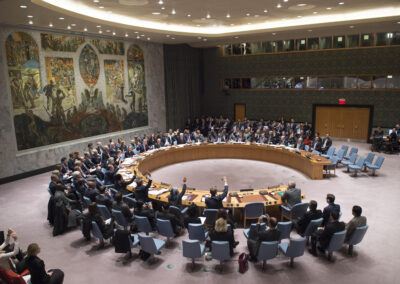
Photo credit: International Campaign to Abolish Nuclear Weapons. CC license available here.