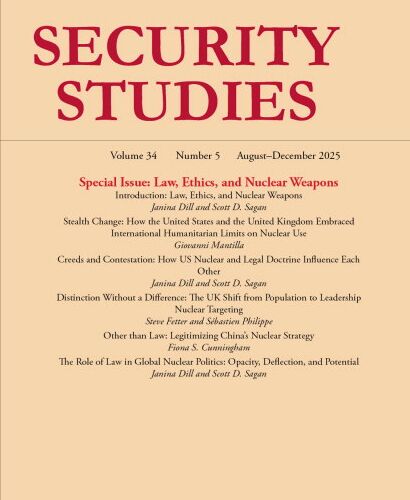
ELAC Co-Director Janina Dill and Scott Sagan (Stanford University) have co-edited a special issue with Security Studies as part of a collaboration between ELAC and the Stanford Center for International Security and Cooperation (CISAC), funded by the MacArthur Foundation and supported by Harvard’s Belfer Center.
This special issue of Security Studies calls for a renewed ethical and legal debate on nuclear deterrence and the potential use of nuclear weapons, arguing that while philosophical and legal discussions faded after the Cold War, nuclear weapons themselves—and doctrines for their use—have not. The editors identify three major developments that make renewed scrutiny urgent: technological changes such as increased missile accuracy and low-yield warheads that may lower the nuclear threshold; a more complex and volatile geopolitical landscape marked by a three-way US-Russia-China arms competition, regional proliferation, and explicit nuclear threats; and the strengthening and clarification of international humanitarian law (IHL), including its growing acceptance as applicable to nuclear weapons. Together, these shifts may increase the perceived “usability” of nuclear weapons, challenging the long-standing notion that they function solely as deterrents of last resort. The volume examines how law and ethics shape (and are shaped by) nuclear doctrine in the United States and United Kingdom, reassess the ethical implications of British targeting policies, and analyse the drivers of China’s nuclear strategy, highlighting the interplay between legal norms, strategic culture, and political decision-making. The issue ultimately seeks both to advance empirical research on how leaders think about nuclear law and ethics and to reignite normative debate about how they should.
“Law, Ethics and Nuclear Weapons” contains four open access articles:
- Giovanni Mantilla presents new archival research showing that international bureaucratic battles and external negotiations led the United Kingdom and the United States to gradually accept that customary IHL (International Humanitarian Law) applies to nuclear weapons. Article Link
- Janina Dill and Scott Sagan argue that the application of IHL to US nuclear plans changed these plans, but in the process the United States also adopted problematic interpretations of IHL to accommodate what we call “deterrence creeds”: untested beliefs about what targets need to be held at risk for effective deterrence. Article Link
- Steve Fetter and Sébastien Philippe combine archival work and modern nuclear effects modeling to argue that a change in nuclear targeting that responded to ethical concerns and was a prerequisite for applying international law to nuclear plans in the UK did not unequivocally improve the ethical or legal standing of British nuclear plans. Article Link
- Fiona Cunningham relies on interview evidence and open-source documents to argue that China’s strategic traditions and domestic politics play a larger role than legal commitments in shaping the emerging Chinese nuclear doctrine in her article aptly entitled “Other than Law”. Article Link
The Special Issue also contains a concluding article in which the co-editors review the role of law in global nuclear politics. The concluding points include:
- the identification of different narratives by which nuclear armed states side-step the question of how their nuclear postures meet the legal restrictions on targeting that they have accepted as applicable to them
- the potential that international law has to contribute to nuclear stability and identify challenges to legalisation;
- why legalisation and disarmament can work together to mitigate nuclear risk; and
- the questions for future research.
Parts of this post have been written with the assistance of AI.