Home > New IPS Policy Paper: ‘Technological Change and the UN Framework of Analysis for Atrocity Crimes’
New IPS Policy Paper: ‘Technological Change and the UN Framework of Analysis for Atrocity Crimes’

Jul 25, 2022

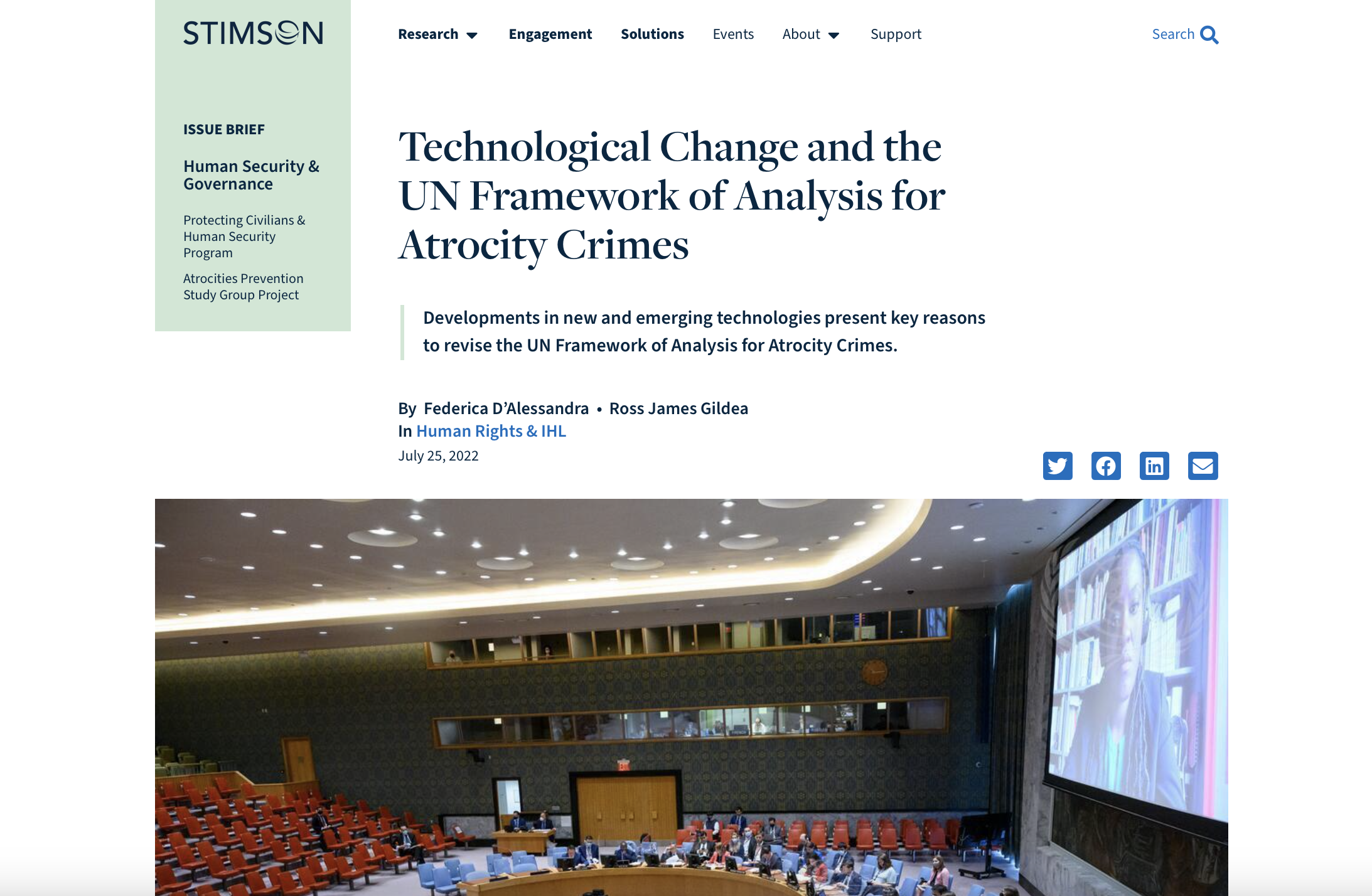
ELAC Deputy Director Federica D’Alessandra and IPS Postdoctoral Research Fellow Ross James Gildea have authored a policy paper, ‘Technological Change and UN Framework of Analysis for Atrocity Crimes’, on key and emerging challenges in atrocity prevention. The paper, which is jointly published by ELAC’s Programme on International Peace and Security (IPS), in conjunction with the Protecting Civilians in Conflict Programme and the Atrocity Prevention Study Group at the Stimson Center, examines the potential need to revise and update the UN Framework of Analysis for Atrocity Crimes—published in 2014 as an integrated analysis and risk assessment tool—given rapid advances in new and emerging technologies since its publication. The authors provide a systematic analysis of risk factors and indicators contained in the Framework of Analysis as well as offering recommendations for how a future iteration of the framework may be enhanced by recognising important technological advances that are changing the nature of mass atrocity prevention and response.

Loading...
Privacy Overview
Oxford Institute for Ethics, Law and Armed Conflict

This website uses cookies so that we can provide you with the best user experience possible. Cookie information is stored in your browser and performs functions such as recognising you when you return to our website and helping our team to understand which sections of the website you find most interesting and useful.

Strictly Necessary Cookies

This website writes one strictly necessary cookie. This cookie lets the site remember whether you have accepted or rejected cookies. You may disable this cookie but doing so will mean that the site will continue to ask you to update your cookie preferences.

Analytics

This website uses Google Analytics to collect anonymous information such as the number of visitors to the site, and the most popular pages.

By default, analytics cookies are disabled. If you enable analytics cookies we'll be able to use analytics data to help us improve this site.

3rd-party cookies

Some pages of this site may contain embedded Youtube videos. Youtube writes a number of cookies when a video is displayed and these cookies are required in order to display the video.

By default, we block cookies like these (otherwise known as 3rd-party cookies), however if you would like to view any embedded Youtube video you should enable 3rd-party cookies here.