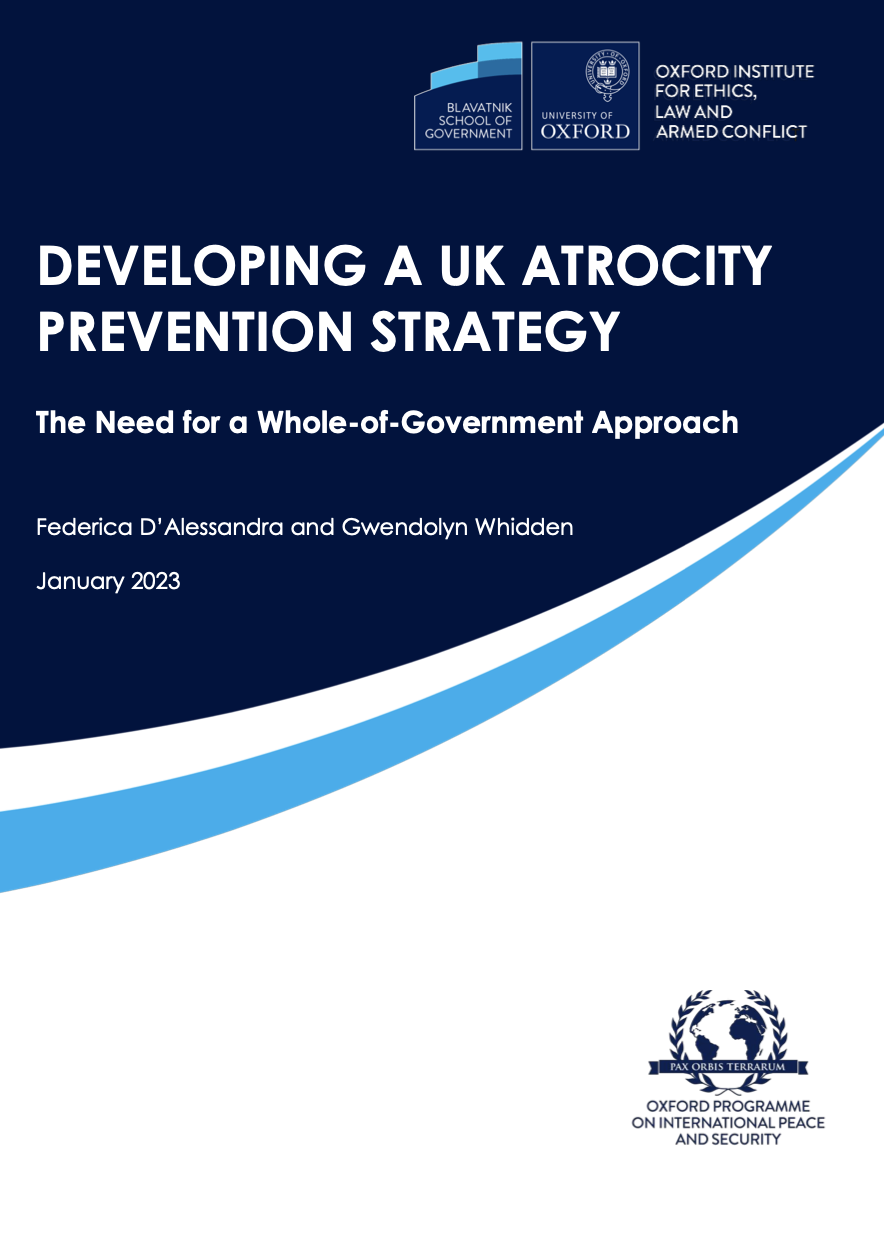
On this annual Holocaust Remembrance Day, ELAC Deputy Director Federica D’Alessandra and Research Assistant Gwendolyn Whidden have published the Oxford Programme on International Peace and Security (IPS)’s latest policy brief, ‘Developing a UK Atrocity Prevention Strategy: The Need for a Whole-of-Government Approach’. A core part of the UK government’s responsibility to act under its commitment to the ‘never again’ pledge is to continually evaluate and strengthen the effectiveness of its atrocity prevention tools, strategies and approaches. To this end, the policy brief evaluates the UK government’s current approach to atrocity prevention and argues that, although atrocity prevention and response are already implicit in both the Her Majesty’s Government (HMG)’s national security strategy and its foreign policy priorities, and while the government has made notable recent commitments with respect to atrocity prevention and response, there are a number of ways in which HMG can yet strengthen this approach.
First and foremost, the brief recommend HMG clearly distinguish its atrocity prevention strategy from its conflict prevention workstream. To do so, it recommends the Foreign, Commonwealth and Development Office (FCDO) develop a national, cross-departmental mass atrocity prevention strategy alongside HMG’s conflict prevention workstream. The brief also recommends the FCDO develop and institutionalise an integrated architecture that coordinates the implementation of such new capabilities across government. Furthermore, the brief advances the view that more research is needed to help policymakers understand how atrocity prevention interacts with other government policies and areas of work. For this reason, it recommends HMG commissions and commits to funding further research on the intersection between atrocity prevention and contiguous workstreams. Finally, the brief proposes a broader set of tools and strategies we believe should be pursued alongside internal bureaucratic restructuring and strategic planning to further strengthen UK commitments to and leadership on atrocity prevention on the global stage, including conducting ‘Atrocity Impact Assessments’, and supporting and strengthening international legal mechanisms to prevent and respond to atrocities.
Read the full brief and recommendations here.